
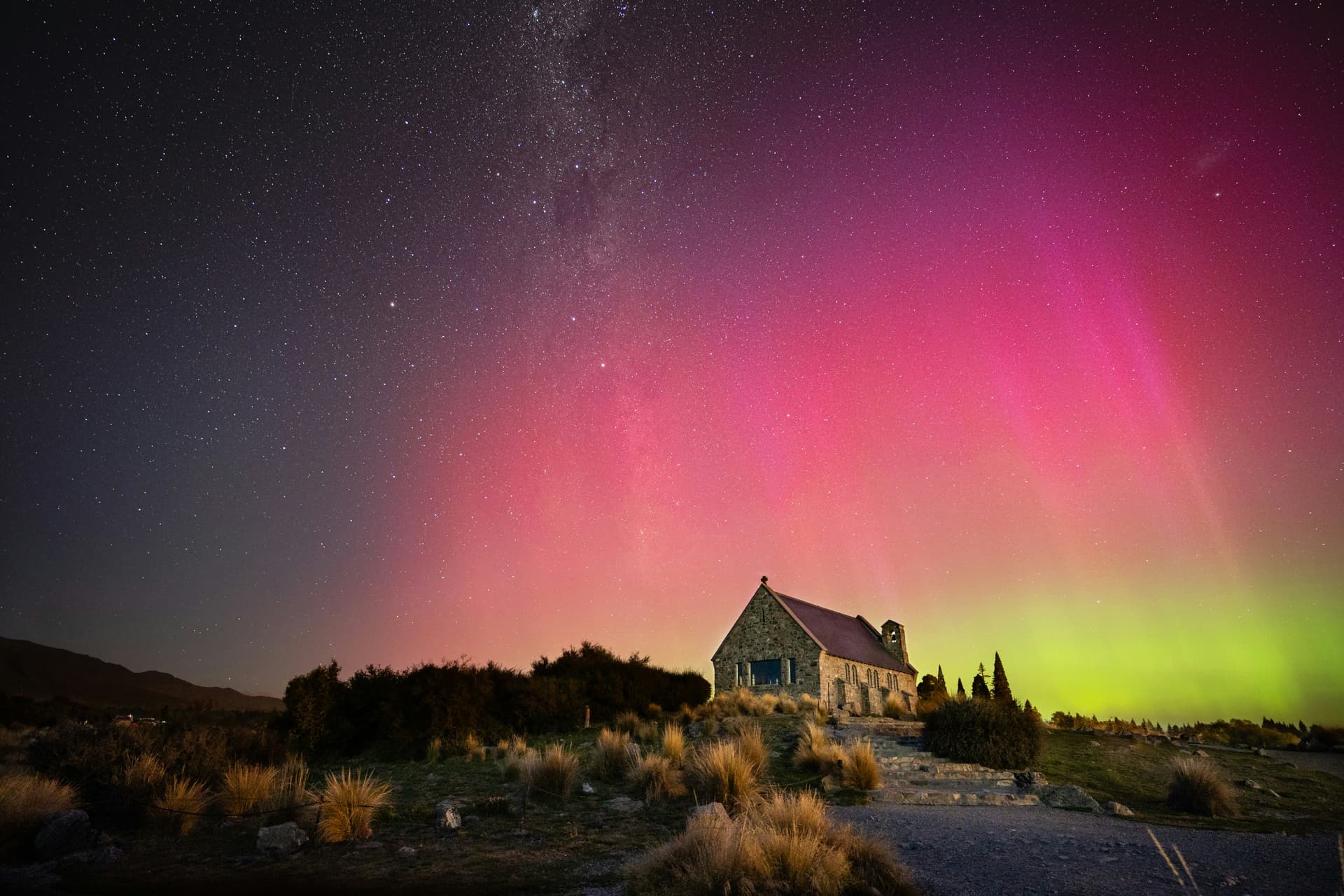
Why Is Lake Tekapo Famous for Stargazing?
Lake Tekapo is located in the Mackenzie region of New Zealand's South Island.
The region is home to the Aoraki Mackenzie International Dark Sky Reserve, established in 2012 to protect its exceptional night skies from light pollution.
Covering approximately 4,367 square kilometres, it is the largest International Dark Sky Reserve in the Southern Hemisphere.
The area's low light pollution and open landscapes create excellent conditions for observing stars, planets, constellations and the Milky Way.
What Can You See in the Night Sky?
The Southern Hemisphere offers a fascinating view of the night sky, including several celestial features that visitors from the Northern Hemisphere may not be familiar with.
Depending on the season and viewing conditions, stargazers may observe:
- The Milky Way: A spectacular band of stars stretching across the night sky.
- The Southern Cross: One of the most recognisable constellations in the Southern Hemisphere.
- The Magellanic Clouds: Two nearby dwarf galaxies visible from the Southern Hemisphere.
- Planets: Jupiter, Saturn and other planets when positioned for viewing.
- Star clusters and nebulae: Beautiful celestial objects visible through suitable telescopes.
The visibility of individual objects changes throughout the year.
Where Can You Experience Stargazing in Lake Tekapo?
There are several ways to enjoy the night sky.
Mount John Observatory
Located above Lake Tekapo, Mount John is an important astronomical research facility operated by the University of Canterbury.
Guided experiences in the area allow visitors to explore the night sky and learn about astronomy.
Dark Sky Project
Dark Sky Project offers guided astronomy experiences in the Aoraki Mackenzie International Dark Sky Reserve, including experiences associated with Mount John Observatory.
It is a popular option for visitors wanting a structured introduction to the southern night sky.
Independent Stargazing
Visitors can also enjoy the night sky independently from suitable public locations.
However, it is important to choose safe viewing locations, avoid disturbing residents and minimise artificial light.
When Is the Best Time for Stargazing?
Stargazing is possible throughout the year, but viewing conditions vary.
The darker period around a new moon is generally preferable because moonlight can make faint stars and the Milky Way harder to see.
Winter offers longer hours of darkness, while summer provides more comfortable outdoor temperatures but shorter nights.
Clear skies are essential for the best viewing experience, and cloud cover can affect visibility in every season.
For photographers, checking moon phases, weather forecasts and the position of the Milky Way before travelling can make a significant difference.
What Should You Pack for a Stargazing Experience?
Even during summer, temperatures can drop considerably after sunset.
Visitors should consider bringing:
- Warm jackets and thermal layers.
- Comfortable closed footwear.
- Gloves and a warm hat during colder months.
- A camera and tripod for astrophotography.
- A red-light torch where permitted.
- Extra batteries for cameras and equipment.
For guided experiences, check what equipment and warm clothing are provided by the operator.
How to Include Lake Tekapo in a South Island Itinerary
Lake Tekapo is conveniently positioned along popular South Island travel routes.
Christchurch – Lake Tekapo – Aoraki / Mount Cook
An excellent combination for travellers interested in alpine scenery, photography and outdoor experiences.
Queenstown – Wānaka – Lake Tekapo – Christchurch
A popular route for visitors exploring several of the South Island's most recognised destinations.
Lake Tekapo – Twizel – Aoraki / Mount Cook
Ideal for travellers who want additional time exploring the Mackenzie region.
For astronomy enthusiasts, consider staying two or more nights in the region to allow flexibility around weather and night-sky conditions.
Why Is Dark Sky Tourism Becoming an Interesting Travel Experience?
Astro-tourism offers travellers something beyond traditional sightseeing.
It combines science, photography, education, nature and cultural storytelling.
For travel agents, this creates opportunities to design special-interest itineraries for astronomy clubs, photographers, educational groups and travellers seeking unique experiences.
A guided stargazing evening can also add a memorable dimension to a South Island holiday without requiring a full day of activities.
Discover the Night Sky with The Rayar Way
New Zealand offers extraordinary opportunities for travellers interested in astronomy and astrophotography.
At The Rayar Way, we can incorporate Lake Tekapo, Aoraki / Mount Cook and other Mackenzie region experiences into customised South Island itineraries.
Whether you are planning a private astronomy holiday, a photography tour or a special-interest group journey, we can help coordinate an itinerary around your interests.
Discover a different side of New Zealand with The Rayar Way.
Frequently Asked Questions
Is Lake Tekapo good for stargazing?
Yes. Its location within the Aoraki Mackenzie International Dark Sky Reserve makes it one of New Zealand's most recognised stargazing destinations.
Can you see the Milky Way from Lake Tekapo?
Yes, when the Milky Way is positioned above the horizon and weather and moonlight conditions are favourable.
How many nights should you spend in Lake Tekapo?
Two nights or more are recommended for travellers who want to include a guided astronomy experience and allow flexibility for changing weather conditions.
Can beginners enjoy stargazing tours?
Absolutely. Guided experiences are suitable for people with little or no previous astronomy knowledge.
Interested in a stargazing or astronomy-focused journey?
Get in touch with our team to create a tailored New Zealand experience.

Comments (0)
No comments yet. Be the first to add one.